
SOLAR HOT WATER
Using the Sun's energy to heat water makes good sense. It will save you energy, lower your hot water bills and reduce greenhouse gas emissions.Solar Hot Water has been used in Australia and the world for decades in various forms.
There are 3 common types of Solar Hot Water that we are accustomed to and are still using today.
Thermosyphon(TS)/ Close Couple system which is when the tank is located on the roof with the flat plate solar collectors attached below the tank.
Split System This is when the flat plate solar collectors are located on the roof and the tank is located on the ground.
Evacuated Tube system is the newest technology in Australia (even though it is actually an Australian invention). It consists of a bank of tubes on the roof and a storage tank on the ground. ANYTHING SOLAR sells the Apricus Evacuated Tube system.
Using the sun's energy to heat water can reduce your household hot water bills by more than 60% each year. Solar hot water systems also help conserve our natural resources and the environment. Converting an existing electric water heater to solar, reduces as much greenhouse pollution as taking one car off the road each year. The Apricus solar water heaters are equipped with gas or electric boosters, to ensure you are never without hot water. Technological advances in recent years mean that evacuated tube systems are now 40% more efficient than their counterparts of 30 years ago, and frost problems have now been eliminated, with with no requirement for an anti-freeze glycol system. Apricus Evacuated Tube System has the anti-frost mechanism into the design and is approved to -15 degrees.
HOW DOES IT WORK?
For solar water heating in your home, there are basically two types of solar collectors; conventional flat-plate collectors, & evacuated tube collectors.
Evacuated tubes have a number of advantages; they work on overcast days in colder weather, and the tubes can be installed and replaced individually.
To put it simply, the evacuated tube acts like a giant thermos , allowing 93% of the sun's radiation in, but only 3-5% out.

The evacuated tube is made of two layers of toughened glass with an evacuated air space in between. Inside the tube is a copper pipe (called a rise), which is the heat conductor. Inside the copper rise, is a small amount of water, which vaporizes into steam and travels to the top of the pipe into the bullet, which is lodged in the manifold. Your hot water is then circulated back to the ground mounted tank. Thermal conduction and convection losses are almost nothing (under 2%) because of the vacuum gap. This design allows the system to work in very low temperatures (approved in Australia to -15 degrees C).
The heated water is then stored in and insulated storage tank. An auxiliary heater (booster) is also included in the system, to boost water temperature on days when solar energy may be insufficient to meet all of your hot water requirements. For example, your solar gain may only be a temperature of 35 degrees, therefore, your boost will only have to compensate for the remaining temperature variance -i.e. 25 degrees.
Storage tanks can vary in size, and rebates may also vary as a result (we can help you with this). Your tank can be made of vitreous enamel, or stainless steel, to which there are advantages for both options.
Again, we can explain this further for you.
ENVIRONMENTAL BENEFITS
A lot of people are now aware of the Black Balloon campaign conducted by Sustainability Victoria, and in that, the following was stated:
Every Victorian household produces over 12 tonnes of greenhouse gas (240,000 black balloons)
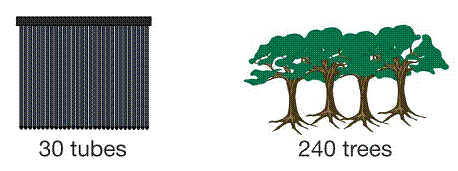
per year. Going solar saves around 60,000 black balloons per household. By installing an Apricus 30 tube Solar Hot Water system, it's equivalent to planting 240 trees.
FROST PROTECTION
Due to the design of the Evacuated Tube Solar Hot Water systems, they require no glycol or anti-freeze chemicals in frost prone areas.
Systems that use glycol lose 10% performance and need regular changing of the glycol, which can be costly. In the case of a flate-plate collector,
where the anti-freeze system has failed and the panel has split, you will not have any solar input into that system at all, and it is costly to replace.
If you have an evacuated tube system and for some reason a tube is broken, you only lose the use of that tube, and it can be replaced individually at low cost.
REBATES
Most Australian governments offer a rebate on Solar Hot Water systems now, as they can see the benefits of the units. These rebates can change from time to time, and state to state. If you would like any information regarding your eligibility for rebates, please ask one of our ANYTHING SOLAR team.

Solar Hot Water
Apricus – www.apricus.com.au
Rebates
Federal
Available in ALL States when replacing an existing electric hot water unit. Renewable Energy Bonus Scheme - Solar Hot Water Rebate Program – www.climatechange.gov.au/
government
/programs-and-rebates/solar-hot-water.aspx
Available in ALL States - Small Technology Certificates (STC’s) - http://green-bank.com.au/recs-calculator.html
Office of Renewable Energy Regulator (ORER) http://www.orer.gov.au/swh/
index.html
Victoria
Federal Solar Hot Water Rebate Program – see above
Regional Solar Hot Water Rebate - Sustainability Victoria www.resourcesmart.vic.gov.
au/for_households_3096.html
Small Technology Certificates (STC’s) – see above
Victorian Energy Efficiency Certificates
(VEEC’s)
NSW
Federal Solar Hot Water Rebate Program – see above
Small Technology Certificates (STC’s) – see above
NSW Home Saver Rebates – NSW Environment
& Heritage – Closed June 2011 www.environment.nsw.gov.au/
rebates/